The ERP software for retail plays a key role in how modern retail businesses stay organized and competitive. It connects sales, inventory, finance, and customer data in one system so businesses can manage daily operations with clarity.
Retail businesses deal with constant pressure from changing demand, multiple sales channels, and tight margins. Without proper system support, small gaps in data often lead to bigger operational and financial issues.
With ERP software for retail, all core functions stay connected in real time. This improves visibility across the business and helps teams make faster and more accurate decisions.
As a result, retail owners gain better control over operations and reduce the risk of errors that affect growth.
What is Retail ERP and How It Works
Understanding what is retail ERP
When we talk about what is retail erp, it refers to a system that connects all retail operations into one unified structure. It removes the gap between departments like sales, inventory, finance, and customer management. Instead of each team working separately, everything flows through a single system that keeps data consistent and updated.
This matters because retail businesses depend on speed and accuracy. A small mismatch in stock or delayed sales data can create bigger issues in planning and revenue. Retail ERP solves this by keeping every function connected in real time.
How it works in daily retail operations
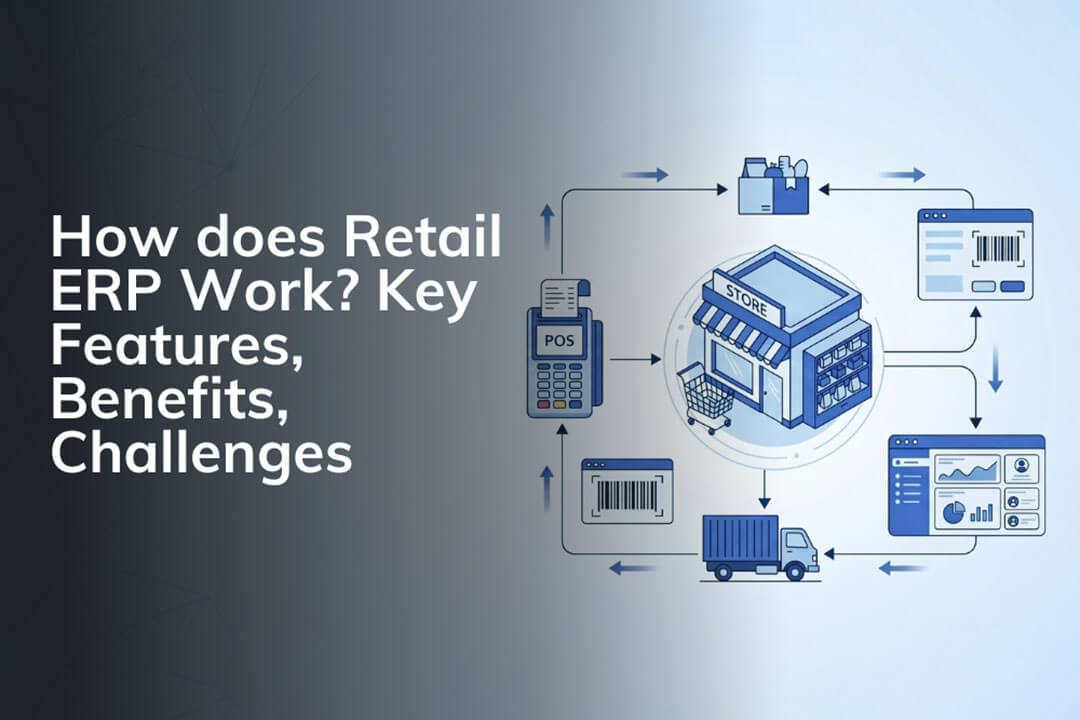
An ERP software for retail business works quietly in the background while capturing every transaction across the business. When a customer makes a purchase at a store or online, the system updates inventory instantly. At the same time, it records the sale in financial reports and adjusts stock levels across locations.
This continuous flow of data removes the need for manual updates. So instead of waiting for end-of-day reports, managers see live business performance at any moment. As a result, decisions become faster, more accurate, and based on real conditions rather than assumptions.
ERP for Retail Industry: Why It Matters
The ERP for retail industry plays a central role in managing the pressure that retail businesses face every day. Demand changes quickly, competition stays high, and customers expect instant service. Without a connected system, operations become scattered and difficult to control.
In many cases, businesses rely on separate tools for billing, inventory, and reporting. This creates communication gaps between teams and leads to delays in decision-making. Small errors in one area can then affect the entire workflow.
However, when everything runs through one system, those gaps disappear. Data moves smoothly across departments, and teams work with the same information. This creates better coordination, clearer planning, and stronger control over daily operations.
Key Features of Retail ERP Systems
Centralized Inventory Management
Retail ERP keeps inventory data updated across all locations in real time. This means businesses always know what is available, what is running low, and what needs restocking. It reduces the risk of both overstocking and stock shortages, which directly protects profit margins.
Point of Sale Integration
Every sale, whether in-store or online, connects directly with the system. This ensures that stock levels, revenue records, and sales reports stay aligned at all times. It removes delays in updating data and improves overall accuracy.
Customer Relationship Management
Customer data stays organized in one place, which helps businesses understand buying behavior and preferences. Over time, this improves how businesses interact with customers and supports more consistent service quality.
Financial Management
All financial movements, including sales, expenses, and profits, stay connected in one system. This gives businesses a clear and updated view of their financial position without relying on separate records.
Supply Chain Visibility
Retail ERP tracks the movement of goods from suppliers to warehouses and then to stores. This visibility helps reduce delays, improve coordination, and ensure that products reach the right place at the right time.
Benefits of ERP Software for Retail Business
Improved Efficiency in Daily Operations
An ERP software for retail business brings structure into daily workflows. Teams no longer waste time on repetitive manual tasks because the system handles routine work in the background. This allows staff to focus on more important areas like customer service and business planning.
Better Customer Experience
It also improves customer experience by enabling faster and more accurate responses. When sales, inventory, and customer data stay connected, teams understand customer needs better. As a result, service becomes more consistent and reliable across all channels.
Stronger Cost Control and Visibility
At the same time, ERP improves cost control. Businesses track inventory usage and financial data in real time. This reduces blind spots that often lead to losses. With clearer visibility, planning becomes more stable and informed.
Easy Support for Business Growth
As businesses expand, ERP supports that growth without adding complexity. New stores, products, or sales channels can be added to the same system. So operations stay organized even when the business scales quickly.
Challenges of Retail ERP Implementation
High initial adjustment
Switching to a new system requires time and patience. Teams need to understand new workflows and adapt to a more structured way of working.
Training requirements
Employees must learn how to use the system properly. Without proper training, even a strong ERP system cannot deliver its full value.
Data migration issues
Moving old data into a new system needs careful handling. Any mistake during this process can affect accuracy in reporting and operations.
Change resistance
Some teams may prefer older methods because they feel familiar. This slows down adoption in the beginning and requires consistent support and communication.
Even with these challenges, businesses gain long-term stability, control, and efficiency once the system is fully in place.
Conclusion
Retail ERP brings all core business functions into one system, making operations more connected and manageable. It improves visibility, reduces errors, and supports better decision-making. Over time, it helps retail businesses operate with more control, stability, and growth confidence.